Are you living paycheck to paycheck? You might be ALICE
Depending on who you ask, there’s no special terminology for a full-time working parent who winces at a surprise car repair bill, for a college student who is struggling to keep up with her bills and who is facing having her water shut off, or for a single elderly person whose social security checks can’t cover typical monthly expenses.
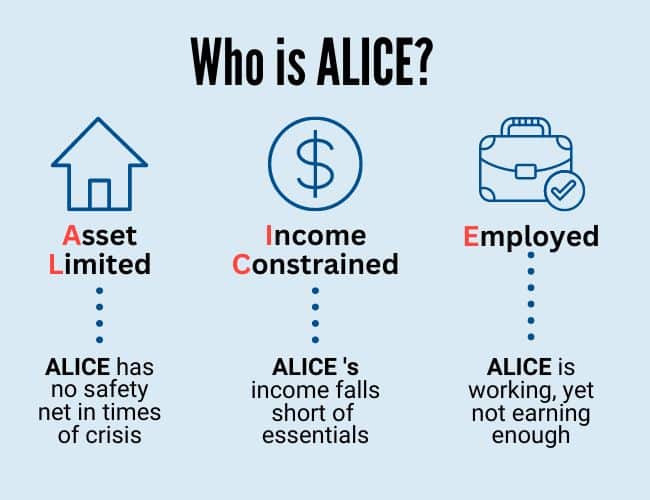
There is an acronym, however, used by United Way, used to describe these examples: Asset Limited, Income Constrained, Employed, or ALICE.
United Way is a nonprofit organization that raises funds through a variety of donors to distribute to its local chapters. Where those monies are funneled to is at least partially spurred by what ALICE data tells the local chapter.
What officially constitutes an “ALICE worker” is based on data for rent, wages, grocery costs, transportation and more within an area.
Those who make enough money to stay above the poverty line, but whose salaries barely edge out typical living expenses, could be called ALICE workers.
The idea is to identify persons or families in communities who don’t qualify for state or federal assistance, but who are highly susceptible to sudden emergency costs or income loss.
And according to the latest data, 56% of Yale households fall under that threshold, which includes those below the poverty line.
That’s significant, said Sharon Wilton, executive director of United Way of St. Clair County, in an August interview with The Expositor.
Countywide, that figure is 39%, which is more in line with the state.
Households above the poverty line but between the ALICE threshold equate to nearly 42.5% of Yale households, compared to 28% in the county.
This type of data cannot necessarily describe what it’s like to live in a town.
In Yale, the Bologna Festival draws thousands, and the admittedly small town serves as a regional hub with several fast food options and restaurants, gas stations and tradesmen calling it home.
The data, however, helps contextualize the town into the grander economic landscape.
As Wilton said, understanding the community — including this data — helps her organization know which grants to apply for or which funding to seek. Folks can reach out to United Way for a variety of needs, like medical equipment loaning, utility shut offs, career readiness and assistance during evictions.
A look at the data
The 56% of Yale households that fall below the ALICE threshold cannot be explained by any one thing, but there are some simple observations and large-scale trends, Wilton said.
“The biggest piece is that our wages in this community are not as high as the cost of living is right now,” said Wilton of the county.
Average rent cost in Yale ranges between $950 and $1,000, based on Apartments.com and Zillow, however, most Yale residents — nearly 80% — own their homes.
Housing data websites show the median home value in Yale to be just under $215,000; those that just bought a home in Yale are likely paying a mortgage in excess of $1,000, if not closer to $1,300.
Rents in the southern parts of the county, such as the regional hub of Port Huron, routinely surpass $1,200 a month.
As for the wages and salaries residents make to afford these rents, three industries comprise the majority of the workforce in Yale, according to the latest American Community Survey and census data.
The employment makeup is quite similar to the county.
Manufacturing, retail trade and education services, health care and social assistance comprise 57% of Yale’s workforce. The city’s median annual earnings in 2024 was $41,397.
A St. Clair County ALICE “survival budget” compiled by United Way for 2024 details $32,448 in baseline expenses for a single adult.
- For line items on the “survival budget,” visit unitedforalice.org/county-reports/michigan.
Adding a child to the mix, and expenses rise to $45,672, based on United Way’s work. For a family of two adults and two children in childcare, it’s $82,896. And for two adults aged 65 and older living together, it’s $53,964.
Population factors
In addition to wages and rents, a town’s population breakdown can affect how ALICE data is realized.
“Everywhere in every county across the state, and really every state, we generally see that older and younger populations are overrepresented in the ALICE data,” said Bobby Dorigo Jones, director of ALICE and Public Policy for the Michigan Association of United Ways.
Poverty rates may be much lower for older communities, thanks to Social Security, but it may not be enough on its own to meet the “survival budget” for seniors.
Commute times are also a notable factor. Nationwide, 51% of ALICE workers had a commute greater than 15 minutes, according to ALICE data.
For Yale workers, there are three most common commute times:
- 29% of Yale workers commute less than 10 minutes, such as those working in town or on the outskirts
- 11.2% commute between 30 and 34 minutes, which is generally the distance to northern Port Huron businesses
- 27.1% commute 60 or more minutes, which could account for employees travelling to the Detroit suburbs, or even Detroit itself.