City votes to split legal fees with C. Roy’s
YALE — The Yale City Council voted last week to split thousands of dollars in legal and engineering fees with C. Roy’s Inc., moving to ease the financial strain on the local business following a lengthy sewer dispute.
With a handful of audience members present, the council moved through its agenda with a few major discussion points, including how to pay the city’s legal fees regarding the C. Roy’s issue and how to proceed with filling the vacant city manager position.
During public comment time, C. Roy’s owner Nancy Roy addressed the council after handing out copies of her prepared statement to each member. In the document, Roy pointed out the timeline of events that have happened since first being notified of violations for dumping animal byproduct into the city’s sewer system.
“On May 27, we were made aware the City of Yale was considering a new sewer ordinance that would not allow slaughterhouses to hook up to the city sewer. That would have closed our business,” Roy said. “Thankfully, the council voted and allowed an amendment so that we could continue to run our business. Unfortunately, after the amendment was passed, we waited several weeks for any response from the city regarding our new user permit.”
According to the business, C. Roy’s learned from the Michigan Farm Bureau that the city had signed an administrative consent order that “would also affect our business,” Roy said.
The longtime Yale business was eventually given a 44-page application to apply for a user permit. Roy’s was told the city attorney had several questions regarding the user permit application, causing further delay.
“We have now met six of the seven parameters the user permit requires. We have separated our sanitary waste from our processed waste. We have done all of the required testing. We have not sent any of our processed wastewater to the city’s sewer system, yet we are still receiving a bill,” Roy said. “[The city] are only receiving our sanitary waste, which the user permit also requires testing.”
Roy added that DPW Supervisor Jason Hart had not communicated directly with them despite all the testing conducted on their lines.
“He has not come into our building to talk to us — he just tests and reports his findings to the city. We would welcome a conversation, but he has refused,” she said.
“Unfortunately, it seems that any hoop that could be thrown our way has been thrown, along with several deliberate delays,” Roy said. “We have tried to remain optimistic and hopeful. We have been told that a normal user permit is not 22 pages long and does not have such restrictive requirements or testing requirements.”
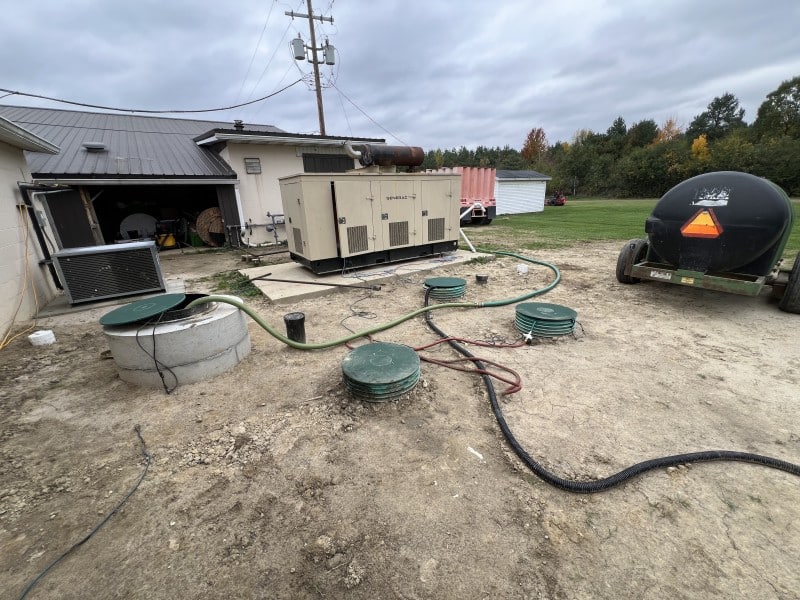
Since the issue was first brought to light in fall 2025, Roy’s has incurred extensive bills to the tune of nearly a quarter-million dollars. The business provided an accounting of bills including over $37,000 for excavation, $67,000 in engineering fees, nearly $50,000 in legal fees, $4,000 in plumbing, another $8,000 for “frac tanks” (which hold wastewater), and more than $7,000 in chemicals.
Altogether, according to Roy, their bills total $203,206.28.
“We are just asking council to consider the full history of our efforts, the financial burden already placed on our business and the importance of reaching a practical solution without imposing further unnecessary costs,” Roy said.
Later in the meeting, council members discussed their own legal and engineering fees related to the Roy situation.
“I put this totally on our [former] city manager,” said Councilman Anthony Hackett, referring to former City Manager Lorrelai Natke, who is suing the city for wrongful termination. “This is not fair to any of us. I say we split our costs [$13,601.25 in attorney fees and $11,791.75 engineering costs] with them right down the middle.”
Others said there was possible future litigation at hand.
“Roy’s has strong grounds for a lawsuit,” Councilmember Shelley O’Brien said. “There are things that happened that should not have happened and it has put a negative light on the city. This has been mishandled from the start.”
Mayor Brenda Krzak said she feels the two sides need to continue to work together and try to resolve the problem.
“I support the idea of splitting the city’s legal and engineering costs with them. It’s better than asking them to foot the entire bill,” Krzak said.
Other council members also expressed frustration with how the municipality had previously handled the ongoing situation with C. Roy’s.
“This whole thing has been done wrong on our part. Previous councils have let this go for decades. Now, all of a sudden it’s a problem? It’s just wrong,” Hackett said.
Hackett then made a motion to split the city’s costs in the case evenly with Roy’s, with each side paying $12,696.50. The motion passed 3-1, with Sharon Krosnicki voting no. Two members, Eric Kleitch and Mayor Pro Tem Tammy Hazel, were not at the meeting.
Other business
- Krzak said she had a meeting with a neighboring mayor who has a side business involving city manager searches. “We don’t want any more screw-ups like we’ve had and I thought he had some good things to say. We could use that firm to help us get a list of candidates to review — someone who knows budgets and finances and someone who can do bookkeeping.” Council fired Natke in August and has relied on Clerk Ashley Aldea to handle the clerk’s role and that of city manager. Aldea is among those expected to apply for the vacant city manager position.
- The council was briefed on an emergency repair at the city’s lift station costing more than $18,000, with payment coming from the city sewer fund. Council members also approved asphalt crack seal work to be done on Park Avenue at a cost of $4,700, with work expected to be completed by this year.
The council’s next regular meeting is set for 7 p.m. Tuesday, Nov. 10.