Nurses rally, accusations: The Dr. Nevin saga isn’t over
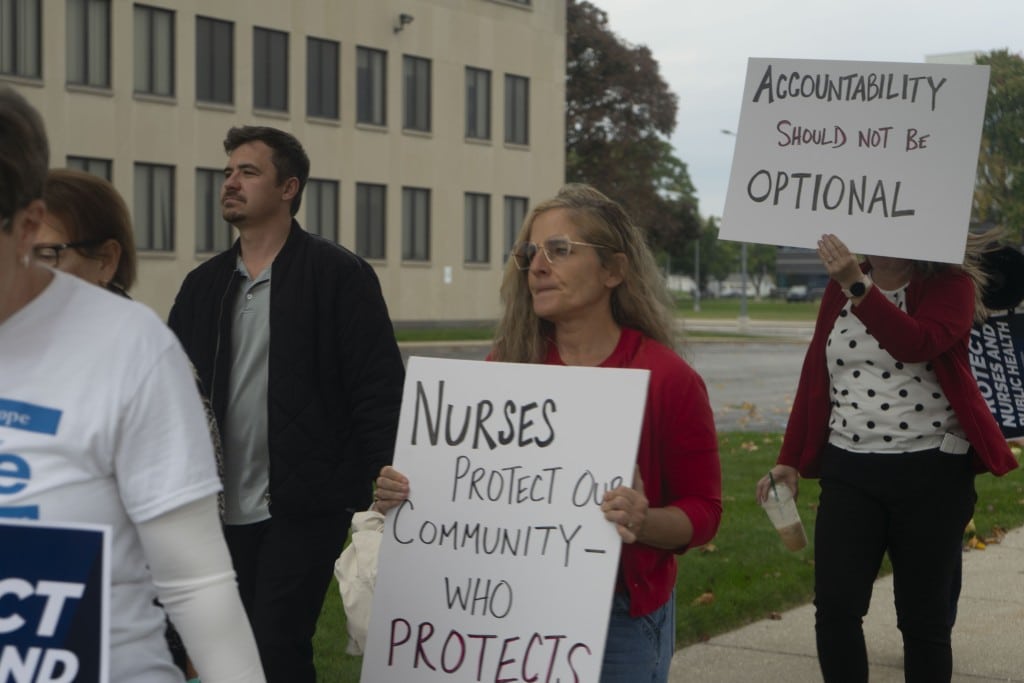
PORT HURON — Health department nurses and community members gathered outside county offices Thursday evening, Oct. 1, to demand an independent investigation into St. Clair County Medical Director Dr. Remington Nevin, pressing local officials as county legal counsel recommended hiring an organizational consultant rather than launching an outside legal probe into multiple employee complaints.
The rally in Kiefer Park, organized by the Michigan Nurses Association, preceded Thursday’s St. Clair County Board of Commissioners meeting, where corporation counsel Tori Ferres presented her review of internal grievances and county records.
The public push follows a Sept. 29 union announcement that county leadership had received 42 signed employee complaints from union and non-union staff alleging workplace harassment, intimidation, and a hostile work environment, with the latest filing dated Sept. 11.
“An independent, impartial investigation is the only path forward because the county has failed for years to act on employee complaints, resulting in nurses and other employees having to work in fear of intimidation, harassment and retaliation,” Jessica Baker, a health department registered nurse and local union president, said in a statement.
County Administrator Thomas Hull said administrative staff forwarded complaints gathered across multiple channels to legal counsel for review ahead of the meeting.
Ferres told commissioners she reviewed hundreds of pages of grievances, hotline reports and prior internal investigations. She categorized the filings into three areas: public health policy disagreements, concerns regarding Nevin’s communication style and allegations of gender discrimination.
Ferres concluded the complaints do not meet the legal threshold for harassment or discrimination that would necessitate an external legal investigation, attributing much of the friction to ideological differences between staff and Nevin over policy shifts.
“Differences of opinion on public health policy do not require an external investigation,” Ferres wrote in her legal opinion.
She noted that while some staff perceive an imbalance of power, Nevin is entitled to maintain his public health philosophy under his contract and state law, provided he complies with statutory duties.
Board Chairman Steven L. Simasko, speaking in his capacity as commissioner for District 1, emphasized that the legal finding identified department-wide dysfunction rooted in policy shifts following Nevin’s appointment rather than misconduct by a single individual.
“After careful and thorough review of all matters submitted to the county attorney, nothing rose to the level of discrimination or harassment that would require any further investigation,” Simasko said in an email to The Expositor. “The written legal opinion of Attorney Ferres found dysfunction within the entire department as a whole, not dysfunction limited to any one person or group of persons.”
Simasko added that at page three of her written opinion, the county attorney identified the friction as centering on ideological differences over what staff referred to as abrupt policy and procedural changes under Nevin.
“Dr. Nevin’s conduct is only one aspect of the many issues contributing to the dysfunction within that department that may require action by the county administrator, Tom Hull, and/or the county board of commissioners going forward,” Simasko said.
Hotline reports, performance plan
Internal county records show administrative concerns surrounding Nevin’s management style date back nearly two years.
A November 2024 human resources report concluded Nevin’s conduct created a toxic environment, citing condescending communication toward female staff and verbal threats. The report called the situation “untenable long term” and cited safety protocol lapses. A county hotline review committee recommended an independent investigation in December 2024, but no outside legal probe was launched.
In April 2026, the Michigan Nurses Association filed an unfair labor practice charge with the Michigan Employment Relations Commission, alleging Nevin retaliated against a nurse who lodged an internal grievance. That case remains open.
Attention on Nevin intensified following disclosures of a recorded July 9 phone call between Nevin, Public Information Officer Alyse Nichols, and Planning Director Brandon Fey regarding a media inquiry.
On the recording, obtained through a Freedom of Information Act request by the Port Huron Times Herald, Nevin accused Nichols of starting a rumor that he carried a weapon.
“There is a well-entrenched myth that I carry a grenade launcher down my pants,” Nevin said on the call, demanding she correct it.
The comment referenced a September 2025 exchange at Harbor Impact Ministries where Nichols and Fey documented that Nevin stated he was carrying a firearm. Nevin denied making the statement or carrying a weapon.
Following an investigation into the July call, Hull determined the comment did not constitute sexual harassment, but termed Nevin’s tone unprofessional and disrespectful.
Nevin was placed on a performance-improvement plan, or PIP, on Sept. 2 requiring professional communication and prohibiting language perceived as intimidating, demeaning or retaliatory.
Ferres recommended keeping Nevin on the PIP while utilizing an organizational consultant to focus on leadership, communication and teamwork.
Simasko characterized the performance plan as the appropriate administrative response.
“The complaints that materialized in late 2024 were preceded by ongoing dysfunction within the department that resulted in the county board restructuring the leadership structure at the department shortly after the COVID-19 pandemic,” Simasko said Monday.
“All issues going back to 2020, including the 2024 complaints, were addressed by county administration, county legal counsel, and the county board through anonymous complaints, formal grievances, legal claims under existing labor law, and internal administrative oversight.”
Simasko pointed to the Sept. 2 performance plan as an example of appropriate remedial action.
“Dr. Nevin’s willingness to abide by the terms of the plan evidence a good-faith effort on his part to improve relations with staff at the department he directs under his medical license,” Simasko said, adding that legal counsel advised no further action is necessary regarding those complaints other than continuing the plan.
Background
Nevin, 51, a Johns Hopkins-trained physician born in Toronto and a former U.S. Army preventive medicine officer, took the part-time post in July 2023 following community friction over pandemic-era health mandates.
Since taking office, Nevin has openly embraced comparisons to U.S. Health Secretary Robert F. Kennedy Jr.
“To the extent that some residents may be comparing us, I would consider that a great compliment and honor,” Nevin said earlier this year. “One underestimates him and the strength of his convictions at their peril.”
Under Nevin’s direction, the health department made it easier for parents to opt out of routine childhood vaccines, campaigned against municipal water fluoridation, removed healthcare services from school clinics, and authored a local ordinance framing utility-scale solar developments as a potential public health threat.
Nevin’s views were shaped during his military career leading research into side effects of the antimalarial drug mefloquine, which led to testimony before the U.S. Senate and Canadian Parliament.
He later founded a nonprofit advocating for veterans affected by drug-induced conditions. Nevin maintains state law does not require him to provide traditional scientific rationales for local policy choices, comparing his approach to emergency measures enforced during COVID-19.
“To this day, no Michigan health official has provided — or been required to provide — a precise scientific or medical rationale for mandating that restaurant patrons wear a mask from the moment they enter until they are seated, only to remove it for the duration of the meal,” Nevin said.
Leadership structure, governance
The labor dispute coincides with structural changes within county health leadership.
Following pandemic-era friction, the board split the health department leadership model into separate administrative health officer and medical director roles. Administrative Health Officer Liz King’s contract auto-renewed in March, while Nevin’s auto-renewed in June.
Both officials recently signed new three-year contracts that eliminate auto-renewal clauses and explicitly define the scope and authority of each position.
Simasko stressed that county employees at all levels deserve respect, but noted that management authority rests with the two contract leaders.
“County employees deserve to be treated with dignity and respect at all times. That said, it is a two-way street,” Simasko said. “The medical director and administrative health officer as county employees in leadership positions also deserve to be treated with respect in the exercise of authority in their respective management roles.”
Citing the legal opinion, Simasko noted that transitioning to operations aligned with Nevin’s policies has proven difficult for health department staff.
“I would expect that some staff may disagree with one or both of them at any given time on any given issue that may lead to disappointment or more intense feelings of displeasure,” Simasko said. “But in the final analysis, everyone in the department must accept the leadership and direction of those vested with that authority.”
Simasko emphasized that his comments reflected his perspective as commissioner for District 1 and not the full seven-member board.
Commissioners voted to waive attorney-client privilege to release Ferres’ written legal opinion publicly. Hull said administrative staff will work with legal counsel and human resources to evaluate hiring a workplace consultant.
Nevin has continued leading public health forums. Last month, he hosted an advisory board workshop examining potential land, water, and power demands of artificial intelligence data centers, presenting land-use planning as an occupational health issue.
At the workshop, Nevin urged communities to evaluate key factors including 24/7 electrical grid demand, cooling water consumption, acreage, location, and on-site generation hazards like noise and emissions.
While emphasizing that his role is to educate rather than take immediate regulatory action, Nevin stressed the importance of helping local municipalities make informed choices.
Township leaders and planning officials advocated for strict, proactive oversight as they craft local ordinances. Officials like Lenox Township’s Olu Jabari and Wales Township’s Kevin Glass highlighted the need for independent expertise, baseline environmental testing, and clear jurisdictional accountability regarding private well protections and water discharges. Wales Township is currently enforcing a second moratorium through January to ensure appropriate safeguards are established before any developments are approved.
Residents and community members expressed deep anxiety over whether smaller rural townships have the resources to enforce regulations against massive corporate developers once facilities are built. Concerns ranged from ongoing noise pollution and property impacts to the preservation of local farmland, waterways, and tribal consultation.
In response, Nevin committed to addressing these issues — including fire hazards, generator testing, and emergency response capabilities — in a follow-up presentation in October.
The St. Clair County Board of Commissioners holds committee meetings on the first Thursday of each month and full board meetings on the third Thursday at the County Administration Building in Port Huron. Meetings are livestreamed on the county’s YouTube channel.
— Sherrie Kleitch contributed to this report.